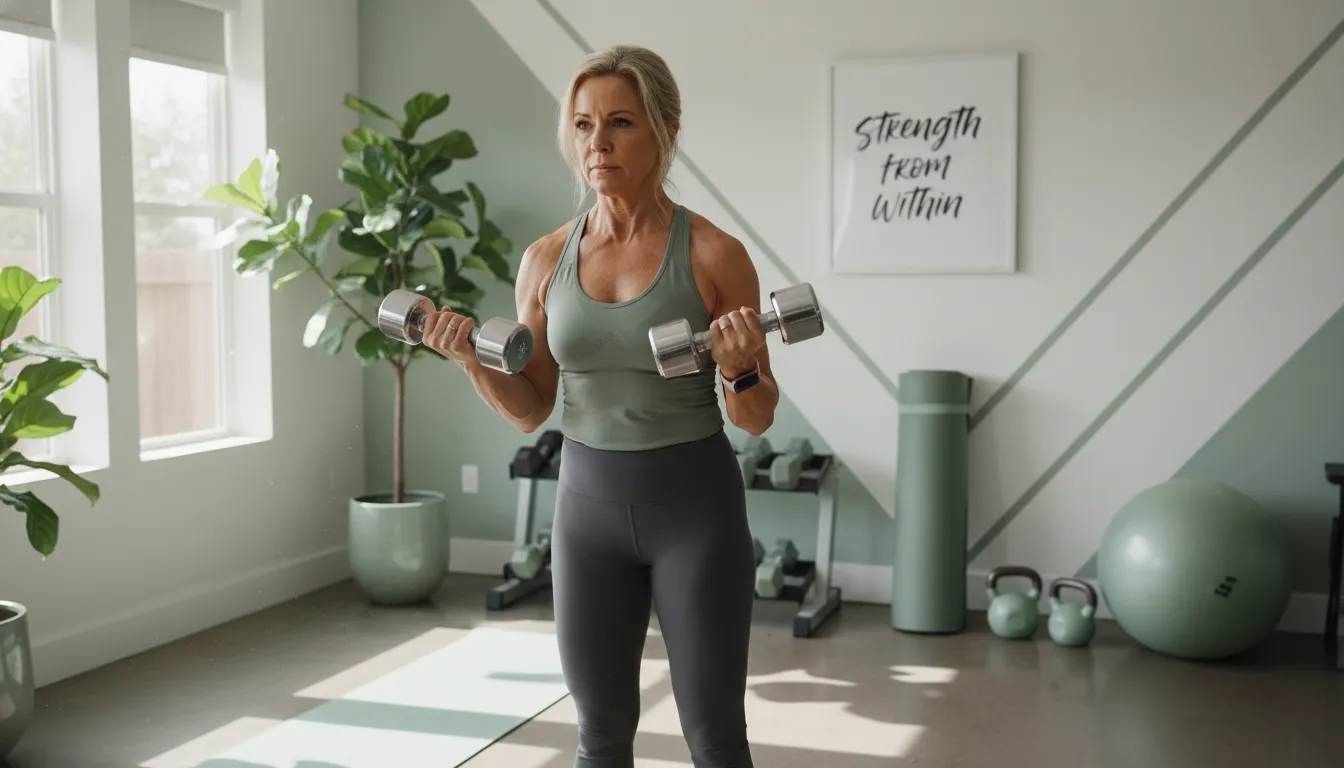
You’re eating the same way you always have. You’re still doing your cardio. You’re doing everything “right” — and yet your body is changing in ways that feel completely out of your control.
I hear this from women every single day. And I want you to know: it’s not your fault, and it’s not a mystery.
After 50, your body has fundamentally changed at the hormonal and physiological level. The approach that kept you lean and energized at 35 simply doesn’t produce the same results anymore. The solution isn’t working harder — it’s working smarter. That means understanding what your body actually needs right now, and building a fitness routine around that reality.
That’s exactly what this guide is for.
Why Everything Changes After 50 (It’s Not Your Fault)
The root cause of most frustrating body changes after 50 is hormonal — specifically, the steep decline in estrogen that comes with perimenopause and menopause.
Here’s what that decline triggers:
- Accelerated muscle loss (sarcopenia). Estrogen plays a role in muscle protein synthesis. As it drops, you lose muscle mass faster — often 1–2% per year without intervention.
- Slowing metabolism. Less muscle means a lower resting metabolic rate. You’re burning fewer calories at rest than you did 10 years ago, even if nothing else changed.
- Fat redistribution. Estrogen influences where your body stores fat. Post-menopause, fat shifts toward the abdomen — even on women who haven’t gained overall weight.
- Bone density loss. Estrogen protects bone. Without it, bone loss accelerates, increasing osteoporosis risk.
- Longer recovery times. Joint lubrication, inflammation regulation, and tissue repair all slow down. High-impact cardio that felt fine at 40 can now cause joint pain, adrenal stress, and excess cortisol.
This is physiology, not willpower. Understanding it is the first step to working with your body instead of against it.
The #1 Exercise Women Over 50 Should Be Doing (It’s Not Cardio)
I know — you’ve been told to do more cardio. Walk more, jog more, take more spin classes. And while cardio has its place, it is not the foundation of fitness for women over 50.
The single most important thing you can do is strength train.
Here’s why this matters so much:
It directly reverses sarcopenia. When you apply progressive resistance to your muscles, you stimulate new muscle protein synthesis — the same process that naturally slows after 50. Strength training is the most effective way to stop and reverse muscle loss at any age.
It protects your bones. Mechanical load on your skeleton — the kind that happens when you lift weights — triggers bone remodeling and new bone formation. Multiple studies confirm that resistance training is one of the strongest non-pharmaceutical tools for reducing osteoporosis risk.
It reduces belly fat. More muscle mass improves insulin sensitivity, which means your body handles blood sugar more efficiently and stores less as abdominal fat. This is why women who strength train consistently see changes in body composition even when the scale doesn’t budge.
It raises your resting metabolism. Every pound of muscle burns more calories at rest than a pound of fat. Building and maintaining muscle is how you shift your metabolic rate in the right direction.
And let me dispel the myth once and for all: lifting weights will not make you “bulky.” Women simply don’t have the testosterone levels required for significant muscle hypertrophy. What you’ll get instead is a leaner, stronger, more defined physique — and a body that functions better every single day.
Two to three strength sessions per week is enough to see real results. You do not need to live in the gym.
A Simple Weekly Fitness Routine for Women Over 50
This is the framework I recommend as a starting point. It balances strength, flexibility, low-impact cardio, and recovery — everything your body needs at this stage.
Monday — Strength Training: Upper Body (45 minutes) Focus on pushing and pulling movements: chest press, dumbbell rows, overhead press, bicep curls, tricep work. Upper body strength supports posture, reduces neck and shoulder tension, and builds the functional strength you use every day.
Tuesday — Pilates or Yoga (30–45 minutes) This is your active recovery and mobility day. Pilates builds deep core stability and improves posture. Yoga increases flexibility and calms the nervous system. Both support your strength training by keeping your joints mobile and reducing injury risk.
Wednesday — Rest or Walk (20–30 minutes) Your body needs recovery time — this is when the adaptation actually happens. A light walk keeps you moving without taxing your system. If you feel good, go for it. If you need true rest, take it.
Thursday — Strength Training: Lower Body (45 minutes) Squats, deadlifts, lunges, glute bridges, calf raises. Lower body strength protects your knees and hips, improves balance and coordination, and is closely linked to longevity and independence as you age.
Friday — Low-Impact Cardio (30 minutes) Walking, cycling, swimming, or the elliptical. This supports cardiovascular health, mood, and circulation without the joint stress of running or high-impact classes. Keep it at a moderate pace — you should be able to hold a conversation.
Saturday & Sunday — Active Recovery Gentle stretching, a leisurely walk, foam rolling, or restorative yoga. This is not “doing nothing” — active recovery accelerates muscle repair and reduces soreness.
This is a template, not a rigid prescription. Adjust it to fit your schedule, your energy levels, and your current fitness. The best routine is the one you’ll actually stick to.
The 5 Best Exercises for Women Over 50 (With Modifications)
These are the movements I come back to again and again — functional, effective, and scalable for every fitness level.
1. Goblet Squat Muscles worked: Quadriceps, glutes, hamstrings, core
Hold a dumbbell or kettlebell at your chest and squat down as if sitting back into a chair. This is one of the safest, most effective lower-body exercises you can do — it builds functional strength for everything from getting off the floor to climbing stairs. Modification: Squat to a chair — touch it lightly and stand back up. As you get stronger, use a lower surface.
2. Romanian Deadlift Muscles worked: Hamstrings, glutes, lower back, core
Hold dumbbells in front of your thighs, hinge at the hips (not the waist), and lower the weights toward the floor while keeping a neutral spine. This builds the posterior chain — the muscles along the back of your body — which are critical for posture and back pain prevention. Modification: Use lighter dumbbells and limit your range of motion until your hamstrings become more flexible.
3. Push-Up (Wall or Modified) Muscles worked: Chest, shoulders, triceps, core
A push-up is one of the most complete upper-body exercises available, and it requires no equipment. It also builds core stability and full-body tension. Modification: Start with wall push-ups (hands on the wall, body at an angle), then progress to an incline (hands on a bench), then full floor push-ups over time.
4. Pilates Bridge Muscles worked: Glutes, hamstrings, core, pelvic floor
Lie on your back with knees bent, feet flat on the floor. Press through your heels to lift your hips into a straight line from knees to shoulders. Hold, then lower slowly. This is exceptional for strengthening the glutes and core while also supporting pelvic floor health — something that becomes increasingly important after 50. Modification: Reduce the height of the lift or place a block between your knees for more stability.
5. Dumbbell Row Muscles worked: Upper back, rear shoulders, biceps
Hinge forward at the hips with a dumbbell in each hand and pull your elbows back and up, squeezing your shoulder blades together. This directly counteracts the forward-rounded posture that comes from sitting, screen time, and daily life — and it’s one of the best exercises for reducing upper back and neck tension. Modification: Use lighter weights and focus on feeling the contraction in your upper back rather than just moving the weight.
What About Pilates? (Yes, Include It)
Pilates deserves its own section because it’s genuinely one of the best complementary practices for women over 50 — and it’s not just a “stretching class.”
Pilates builds deep core stability, which is the foundation for every other movement in your life. It improves balance and coordination (critical for fall prevention), enhances postural alignment, and increases flexibility without the joint stress of high-impact exercise.
For women navigating hormonal changes, Pilates is particularly valuable for pelvic floor health. The pelvic floor weakens with declining estrogen levels and is often completely ignored in conventional fitness programs. Pilates systematically addresses it.
Wall Pilates has become especially popular in recent years — and for good reason. It requires no equipment, can be done in a small space, and provides enough resistance and feedback to deliver real results. If you’re not sure where to start with Pilates, wall-based routines are an excellent entry point.
How to Start If You Haven’t Exercised in Years
The biggest mistake I see women make is starting too hard and burning out in two weeks. Please don’t do this to yourself.
Start where you actually are, not where you think you should be.
In your first week: two 20-minute walks and one 20-minute bodyweight strength session. That’s it. It sounds simple because it is — and that’s the point. You’re building the habit first, the fitness second.
Each week, add a little more: an extra set, a slightly heavier weight, an extra session. Progress is not linear, and some weeks will be better than others. That’s normal.
Learn to distinguish between soreness (a dull ache in the muscle 24–48 hours after exercise — normal and expected) and pain (sharp, joint-specific, or immediate — stop and rest). Soreness means you worked your muscles. Pain means something is wrong.
Most importantly: consistency beats intensity every time. Three moderate 45-minute workouts per week, done consistently for six months, will transform your body and your health more than any extreme program done for three weeks.
For a deeper dive into how nutrition supports your fitness results after 50, that’s the next piece of the puzzle — what you eat directly impacts muscle recovery, energy levels, and body composition.
Bottom Line
Your body is more capable than you think. It is not broken, it is not fighting you — it has simply changed, and it needs a different approach.
Strength training + Pilates + smart recovery is the formula that works for women over 50. It works because it addresses the actual physiological changes happening in your body: muscle loss, bone density, metabolism, hormonal shifts, and joint health.
You don’t need to work harder. You need to work smarter — with movements designed for where your body is right now, not where it was 20 years ago.
Start with two strength sessions and one Pilates session this week. Build from there. Give it 90 days and pay attention to how different you feel — not just how you look.
You’ve got this.